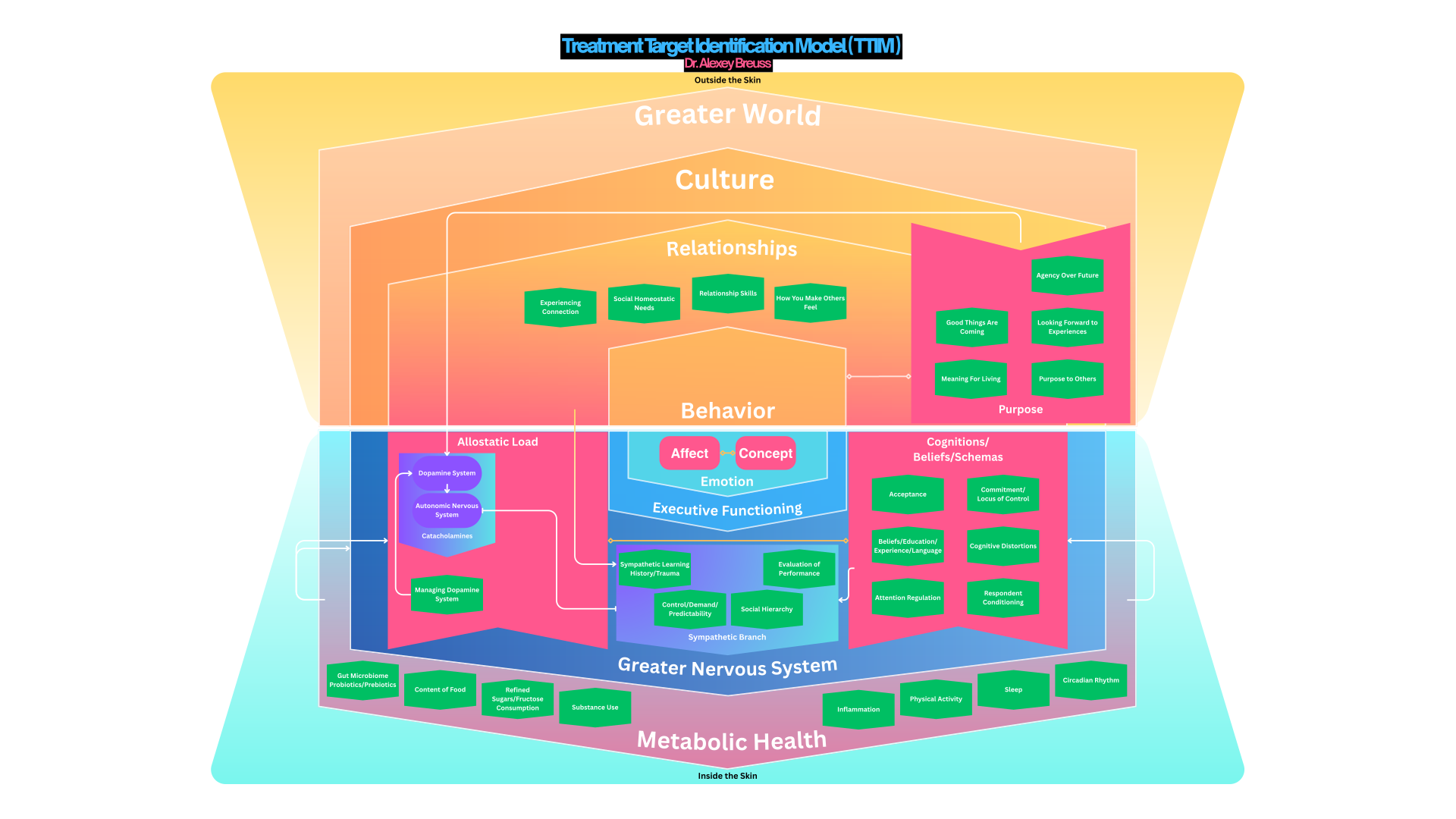
A unifying map for clinicians: instead of inventing new therapies, the TTIM helps you find what is missing in a person's life for a good lived experience — and which evidence-based targets to treat.
Proposed by Alexey Breuss, Psy.D.
Mental health interventions show consistent, moderate benefit — yet distress keeps rising and relapse is common. The TTIM proposes that our interventions don't need an overhaul. What needs refining is which targets we choose, and how we conceptualize them.
of people who begin therapy end treatment without reliable improvement.
deteriorate over the course of treatment despite our best evidence-based care.
truly new mechanisms — most modalities re-articulate the same enduring human processes.
"The interventions we have don't need further editing — instead, treatment-target selection and better case conceptualization warrant refinement."
The TTIM is a visual, mechanism-oriented tool for case conceptualization. It is built to be used three ways — in education, in supervision, and in individual case formulation — and it deliberately targets "poor lived experience," not just diagnosable pathology.
The TTIM grounds intervention selection in established biological and psychological mechanisms, rather than chasing isolated symptoms or single diagnoses.
The TTIM bridges psychological and biological conceptualizations, giving medical and mental-health providers a common map they can both read.
Training in guiding questions can surface targets quickly, the formulation evolves as therapy unfolds, and the model expands as the evidence base does.
The TTIM defines lived experience as a firsthand, subjective, personal experience of/reaction to one's environment. This deliberately includes people who present for therapy not because of their own pathology, but because of distress in those around them, or because they are navigating disempowering systems and hard conditions — while still retaining assessment for psychological pathology.
The Theory of Constructed Emotion at the heart of the TTIM draws on research spanning diverse global populations — from Western to indigenous peoples — which shows that emotions are not universal but vary with culture, language, and context. Because of that foundation, the TTIM treats culture as a required step in every formulation rather than an afterthought. It helps clinicians distinguish what is innate human biology from what is culturally shaped, supports care when client and clinician share little common life experience, and is designed to act as a protective tool for clients who are culturally different or marginalized.
The TTIM is built on the Theory of Constructed Emotion and the biology of allostasis: the brain's constant prediction of the body's needs. Emotions emerge as the brain interprets bodily affect through learned concepts. When that predictive process goes awry, distress follows.
In the full model, Affect and Concept grow into two of the pillars — Allostatic Load and Cognitions — joined because together they produce an emotional experience.
Metabolic Health shapes the Greater Nervous System, which produces Emotion (Affect + Concept). Executive Functioning gets special attention for its power to act on concept over raw affect.
The Greater World, Culture, Relationships and Behavior bidirectionally shape — and are shaped by — what happens inside. Biology and environment are inseparable from lived experience.
Each pillar is a domain that must be maintained for positive mental health and a good lived experience. They are heavily interconnected — a deficit in one ripples through the others.
Tap any pillar to jump into the interactive explorer ↓
Choose a pillar, then select any treatment target to see its rationale, the guiding questions a clinician can ask, and sample evidence-based interventions.
The model is meant to be used as a living cycle — surfacing targets, sharing them with the client, and planning collaboratively as the picture evolves.
Use the guiding questions during intake. Each flagged target invites deeper evaluation, building an idiographic picture of which pillars are in deficit.
Show the client the pillars and targets in deficit. Matter-of-fact psychoeducation reduces judgment, builds alliance, fosters hope, and is itself an intervention.
Choose targets collaboratively. The most destabilizing ones (often Allostatic Load) come first. Re-prioritize as new data arrives — the cycle repeats.
The TTIM never claims a single factor predicts all outcomes. Instead it asks where internal and external factors sit in excess or deficit, and how those imbalances ripple through a life — an idea echoed in traditional models of restoring balance and research on trauma and resilience.
Executive functioning isn't a pillar — you don't need it to feel positive emotion — but it influences nearly every outcome and every session. The model keeps it visible as a consideration across all targets (e.g., CBT for ADHD, environmental structuring, bottom-up regulatory strategies). Modern research does not support the idea that interventions targetting executive functioning have long-term effects, and instead, executive functioning can be scaffolded as a part of treatment. Guiding question: Does the client experience executive functioning deficits? (e.g., use an existing tool such as the BRIEF2.)
The TTIM is not static. It is built to adapt to different practice environments and acuity levels, and to let clinicians add, move, or remove treatment targets wherever a need arises — placing each one where it belongs in the model. As new research and modalities emerge, the framework expands with them.